How We Decreased Cost Per Lead by 70% in a Single Day for Elite Primary Health
The practice ran its own Facebook and Instagram ads between 2nd and 7th November 2026 at R54.45 per lead. Mashilo Digital took over the account, rebuilt the creative around a real offer with real people and a voiceover, and on 9 November the account was delivering leads at R17.17. Seventeen enquiries in one day, on R292.68 of spend.
One day. One creative. 70% less per lead.
This is the moment the account turned. The numbers below are Meta Ads Manager, read on 9 November 2026, one day after we at Mashilo Digital took over this account.
Elite Primary Health ran its own Facebook and Instagram ads between 2 and 7 November 2026 at R54.45 per lead. Mashilo Digital took over the account, rebuilt the creative around a real offer with real people and a voiceover, and on 9 November the account was delivering leads at R17.17. The whole move cost one day, not one month.
What the campaign produced
Every figure below is read from Meta Ads Manager on 9 November 2026. The reporting window is 11 October to 9 November 2026 unless a caption states otherwise. Leads are form submissions, not confirmed patients.
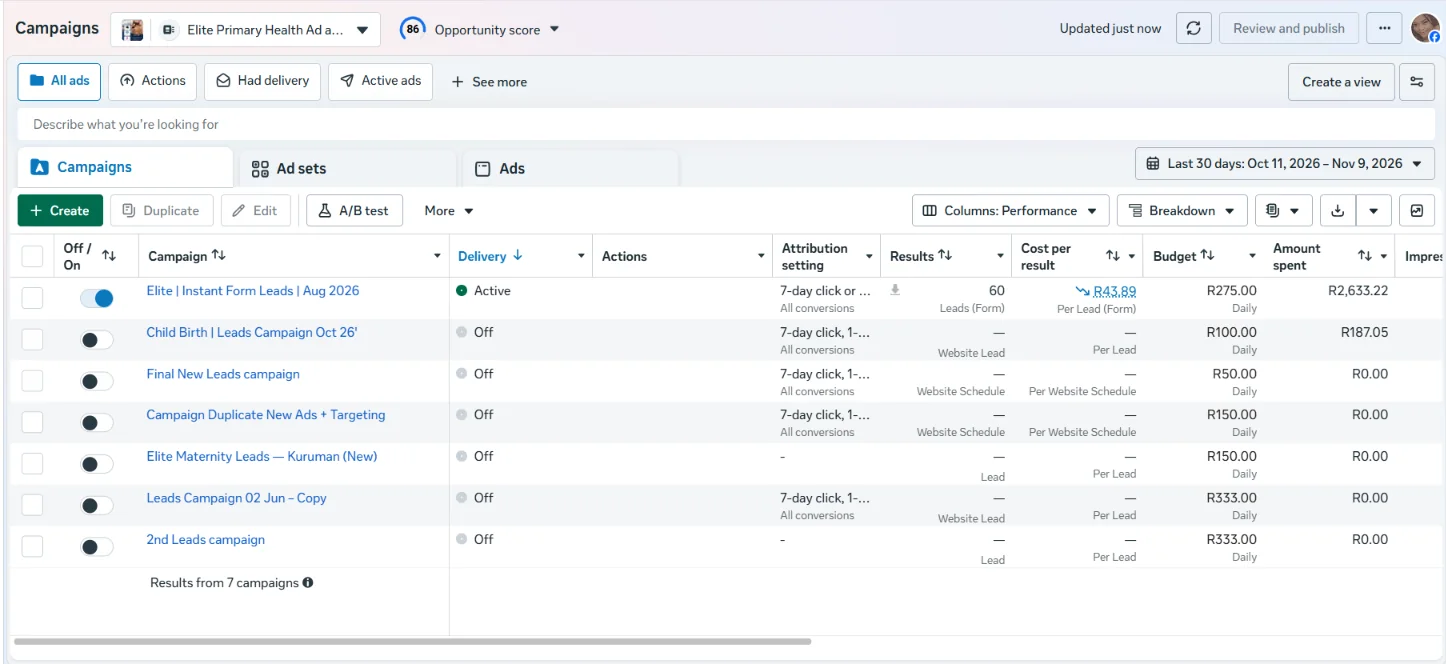
Form leads recorded on the active campaign across the 30 days to 9 November 2026.
Average cost per form lead across that window, R2,633.22 spent on a R275 daily budget.
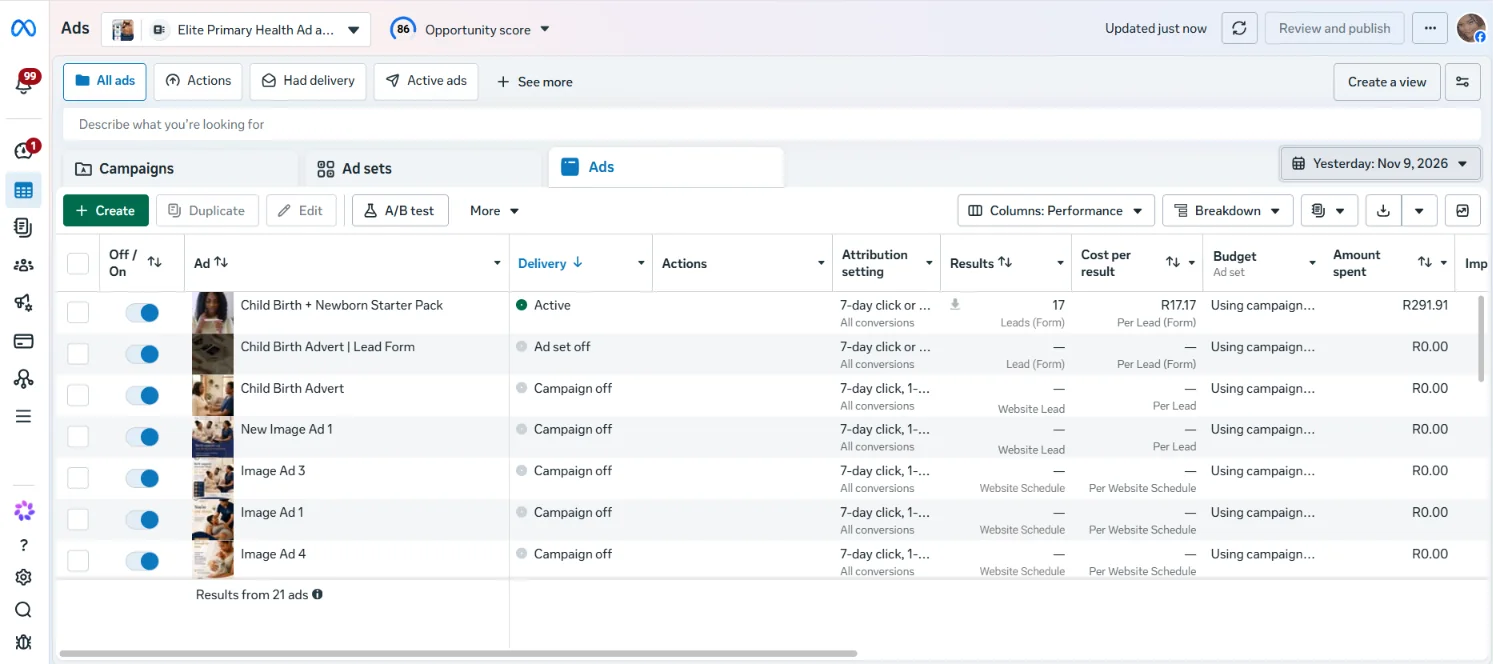
Form leads delivered by the offer-led ad on 9 November 2026 alone.
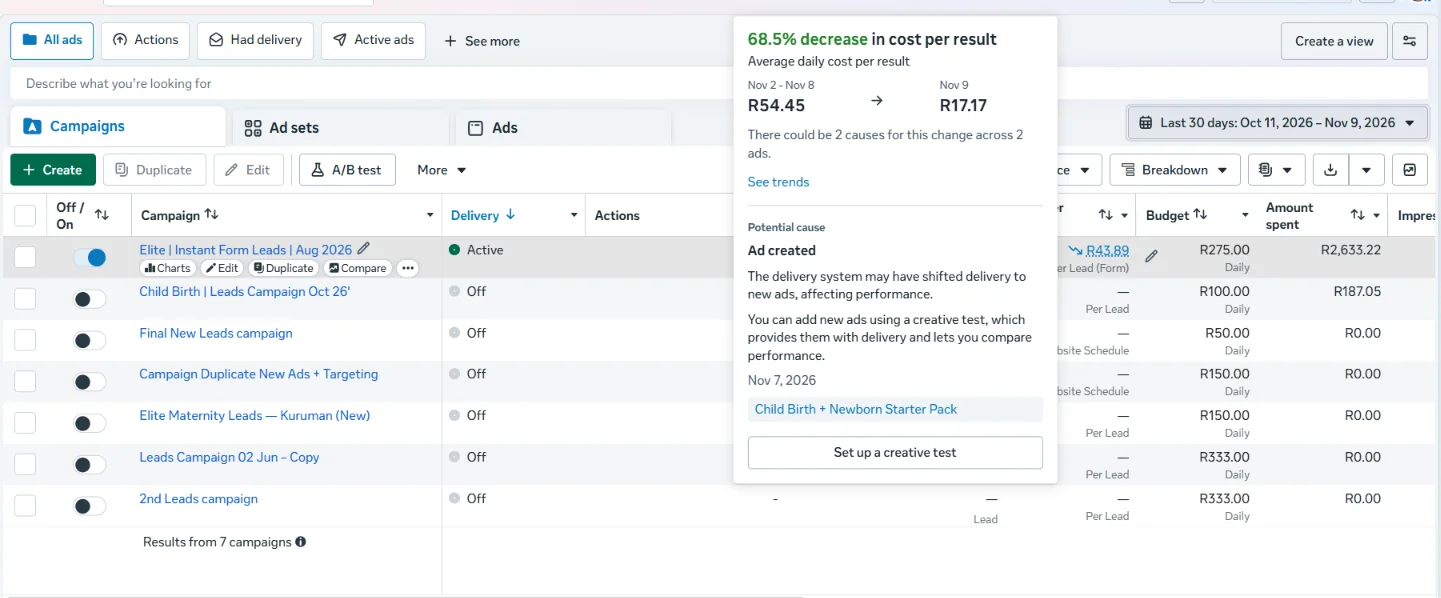
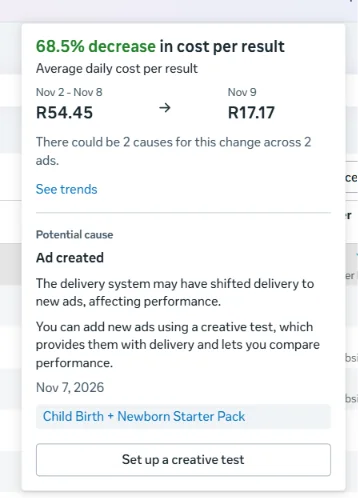
Decrease in cost per result, from R54.45 per lead to R17.17, in one day.
Generated imagery versus real people
Same practice, same platform, same audience. The creative changed from generated to filmed, and the cost of a lead changed with it.
Before: generated creative
Before
The creatives the practice was running were built on AI generated images and AI generated video. They looked like a category, not like a midwife holding your baby, and prospects read them that way. Trust was thin, the offer was vague, and cost per lead sat at R54.45 for the whole week the client ran the account alone.
- AI generated imagery, recognisable as AI to a scrolling audience
- No original offer, so the ad asked for a booking instead of a reply
- Long copy inside the image, nothing to read in a second
After: real people, real voice
After

Mashilo Digital rebuilt the creative on real photographs of real patients, cut with a voiceover from a real midwife. Nothing in the ad looked generated, and it sounded like a person. Trust moved, and the cost of a lead moved with it: 17 leads in a single day at R17.17.
- Real patients, real clinic, real names
- Video creative with a human voiceover
- A concrete offer inside the ad, with the form doing the work
From no offer to the Newborn Starter Kit
Before this campaign the account had nothing to put in front of a prospect. The gesture the practice already made with every new mother became the reason to reply.
No offer at all
The account had no offer to put in front of a prospect. The ad asked people to book a birth tour, which is a big ask for a first time mother who has not chosen a clinic yet. Nothing in the creative said why she should reply today.
What we changed: the practice already gave every new mother a newborn starter kit after delivery. We put that existing gesture inside the ad as the offer, limited it to 20 mothers so the scarcity was honest, and listed what was in the kit.
The Newborn Starter Kit
Free for the first 20 mothers who book, delivered after the birth.

Leads qualified and nurtured without waiting for the clinic
Advertising that produces a reply is only half of the job. Mashilo Digital built the tools that pick the enquiry up the moment it arrives, and keep it moving when the team is with a patient.
Lead qualifying on WhatsApp
The moment a prospect writes in, the tool takes over the qualifying conversation. It confirms the service they need, where they are, whether they are already booked and when they are due, then hands over a short, useful summary to the team.
- Answers service, location and timing questions immediately
- Gives the team a qualified brief, not a pile of messages
- Keeps the lead warm while the clinic is with a patient
Lead nurturing that runs on its own
After hours and between appointments, the nurturing tool keeps the conversation going. It holds the thread, replies fast with the information a prospect actually asked for, and books appointments autonomously.
- Keeps answering after the clinic closes
- Responds in seconds, not next morning
- Books the birth tour without a human in the loop
One objective, one conversion event, one clear offer
The account did not need more campaigns. It needed a decision about what counts as a result, and creative that gives a person a reason to act now rather than later.
A. Campaign strategy
We consolidated the account onto a single lead generation campaign using Meta instant forms. One campaign, one conversion event, one budget to optimise against. Form leads were chosen over website bookings because the conversion happens inside Facebook or Instagram: no page load, no separate booking step, and a contactable enquiry at the end of it.
B. Audience targeting
Targeting was built around geography first. The campaign ran to people in Kuruman and the surrounding Northern Cape communities, with the offer written in plain, local language rather than medical terminology. Broad in-area delivery was used instead of narrow interest stacks, because the audience inside a plausible radius is small enough that heavy interest layering starves delivery. Exact audience sizes and interest settings are not published here: this case study reports what the campaign produced, not a configuration to copy.
C. Advertising creatives and messaging
Three message routes went into rotation, each answering a different question a pregnant woman is asking. Every frame was shot with real people and paired with a voiceover from a real midwife, because trust in healthcare is built on faces and voices, not on stock-looking perfection.
Continuity of care
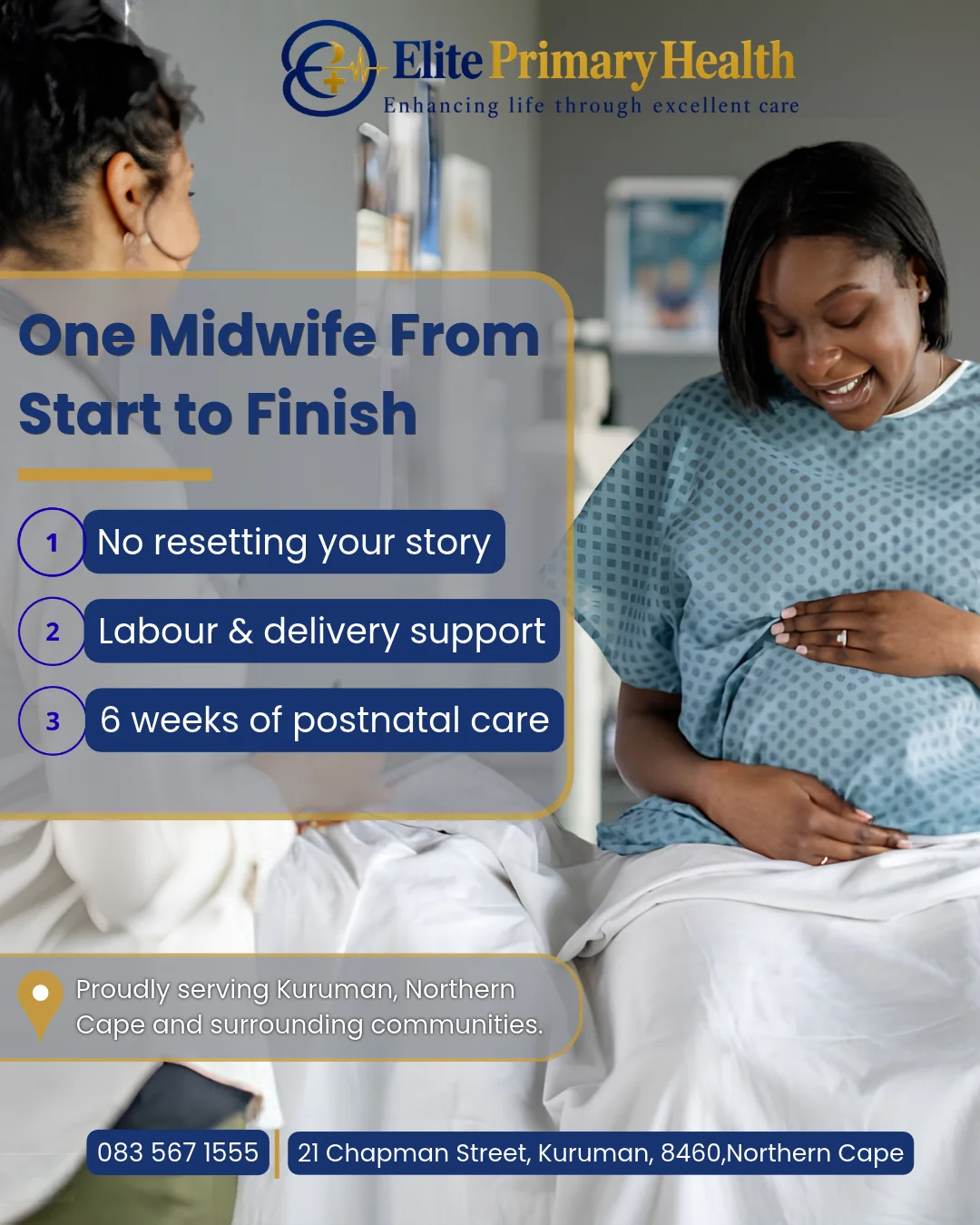
“One Midwife From Start to Finish” breaks the model into three points: no resetting your story, labour and delivery support, six weeks of postnatal care.
Emotional support
“We’re With You, Right Through to Your Baby’s Birth” leads with the relationship, then puts the location promise and a call button directly under it.
A specific offer
“Free Newborn Starter Kit”, limited to 20 mothers, with the contents listed. This is the creative that moved cost per lead.
Design decisions were made for a phone screen. Short overlay text instead of paragraph copy. One call to action per creative. A visible location banner, because "do you serve my area" is the first objection in a rural catchment. Contact buttons embedded in the image, so a person who does not tap through still has a route to the practice.
D. Campaign execution
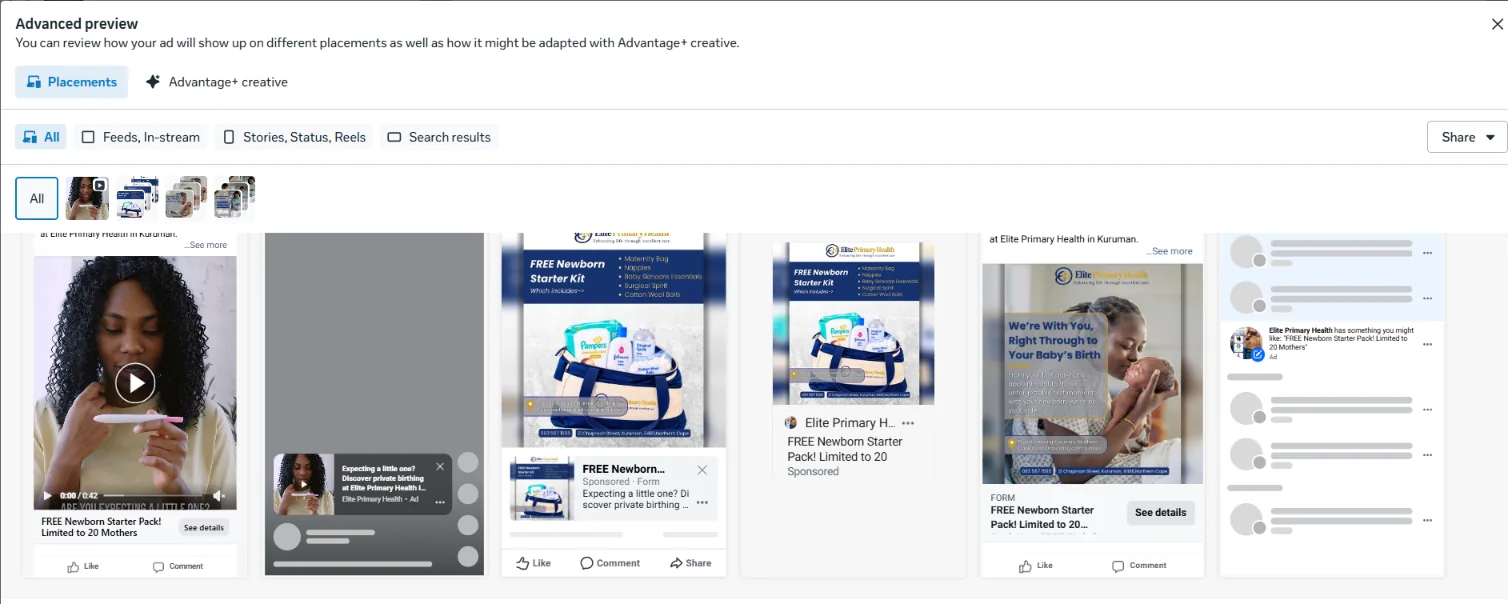
Campaigns were named for what they actually do ("Elite | Instant Form Leads | Aug 2026", "Child Birth | Leads Campaign Oct 26") so performance could be read without guessing. The lead campaign ran on a R275 daily budget. Creatives were previewed across placements, including feed, stories and search results, before spend went live.
E. Campaign optimisation
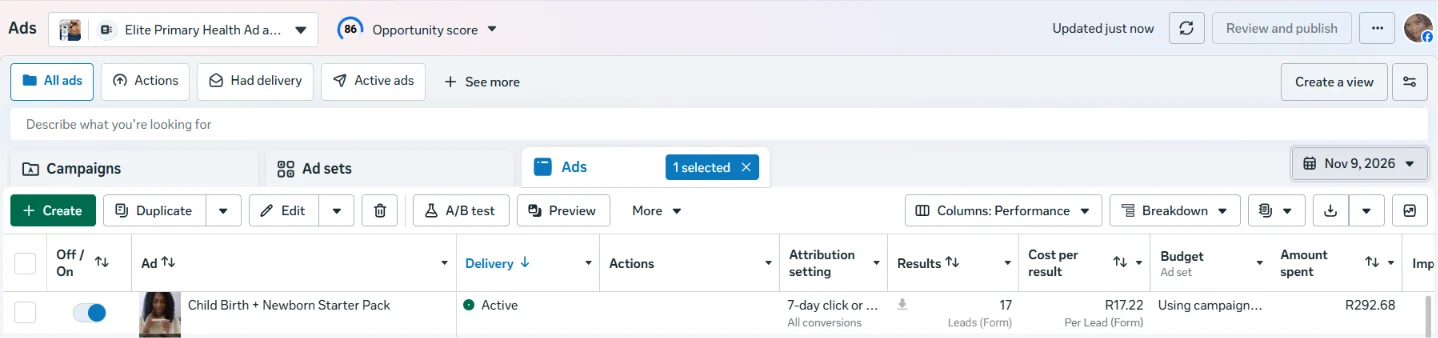
Old campaigns stayed paused rather than competing for the same audience. The active work was creative: a new ad, "Child Birth + Newborn Starter Pack", created on 7 November 2026, took the offer route with the practice’s own branding and a voiceover. Two days later Meta reported that delivery had shifted toward the new ad and that average daily cost per result had fallen 68.5%. The optimisation decision was to push the offer route harder, not to widen targeting or add budget.
Inside Meta Ads Manager
Both screenshots were captured from the live ad account on 9 November 2026. They show the account level view and the ad level view, which is where the cost change is visible.
The campaign creative set
Three message routes, two formats and a placement preview. Tap any image to inspect it at full size.
Campaign timeline
Stages below reflect work completed on this account. Dates are given only where the ad account records them.
-
Stage 01
Account audit
Seven campaigns, six of them paused, and one line of real delivery. The client had been running the account themselves between 2 and 7 November at R54.45 per lead.
-
Stage 02
Consolidation
One campaign, one conversion event, one budget to optimise against. Instant forms replaced the website booking path.
-
Stage 03
The offer
The Newborn Starter Kit, limited to the first 20 mothers, pulled out of what the practice already did and put into the ad.
-
Stage 04
Real creative
Photographs of real patients, cut with a voiceover from a real midwife. Three message routes, static and video, in the practice's own identity.
-
Stage 05
Launch, 9 November 2026
"Child Birth + Newborn Starter Pack" went live and delivered 17 form leads at R17.17 in a single day.
-
Stage 06
WhatsApp desk
Qualifying and nurturing moved onto WhatsApp, so a reply never waits for the clinic to be free.
-
Stage 07
Reporting
Results read at ad level, with leads counted separately from patients so the numbers stay honest.
What the numbers actually mean
Meta reports two different averages in the same account, and they measure different things. Reading them as one number is the most common mistake in a case study like this.
R43.89 is the window average
R2,633.22 spent divided by 60 leads gives R43.89. That is the blended cost of every form lead across 30 days, including days when the older creative was still running.
R54.45 is the recent daily average
Across 2 to 8 November, the days immediately before the new ad, Meta puts average daily cost per result at R54.45. This is the baseline the optimisation was measured against.
R17.17 is a single day
On 9 November the offer ad brought 17 leads on R291.91. Two days of delivery is evidence of a direction, not a promise of a permanent cost per lead.
The 68.5% figure is Meta’s own calculation, comparing R54.45 with R17.17. We report it as their figure, not ours, and we keep the window it covers next to it. One day of delivery is a direction, not a permanent price: the 30-day average on the campaign was R43.89. What the account demonstrates is that the creative, and specifically the move to a limited offer inside an instant form, produced the largest single change in cost this account had seen. What it does not demonstrate is that 60 leads became 60 patients. Leads are form submissions. Bookings and births happen outside the ad account, and we have no verified patient acquisition number to put beside them.
Five things this campaign proved, and one it did not
1. Consolidation beats addition
Seven campaigns produced one line of delivery. Cutting to one campaign did not shrink the result, it made the result readable, which is the only way to optimise it.
2. In healthcare, the offer carries the ad
“Book your birth tour” asks for a meeting. “Free newborn starter kit, limited to 20 mothers” asks for a name and a phone number. The second is a smaller ask, and it is specific.
3. Location belongs in the creative
In a rural catchment, “do you serve my area” is the first question. Naming Kuruman and the surrounding communities inside the ad stopped that question from ending the scroll.
4. Generated creative costs more than it saves
The same account, the same audience and the same budget produced R54.45 per lead with AI generated images and R17.17 with real people and a voiceover. Generated creative looked cheaper to make and paid for itself every time it ran.
5. Read cohort cost, not one good day
R17.17 is the best day in the data. R43.89 is what 30 days actually cost. A practice budgeting from a single day would over-commit.
The one it did not prove
We cannot claim advertising leads became paying patients. The ad account ends at the form submission. Anyone who tells a healthcare client that a cost per lead is a cost per patient is guessing.
Questions about Meta Ads for healthcare
Can Facebook Ads generate patient enquiries for a private healthcare practice?
Yes. Meta instant forms collect a name and contact details without sending the person to a website first, which suits a service people are still deciding about. In this campaign 60 form leads were recorded over 30 days. The practice then decides who to call, so the advertising generates enquiries rather than appointments, and the two should not be confused.
How much does it cost to generate leads through Meta Ads?
It depends on the service, the area and the offer. In this campaign the average cost per lead was R43.89 across 11 October to 9 November 2026, and the best recorded day was R17.17 on 9 November 2026. Treat those as this account's history, not a quote. A healthcare client should agree on a target cost before the campaign runs, and read cost per lead alongside lead volume.
Are Facebook and Instagram ads effective for maternity clinics?
They can be, because the audience is local and the message is personal. Facebook and Instagram placements in this campaign carried a video and static versions of the same offer, and the placement preview showed how each adapted across feed, stories and search. Effectiveness depends on whether the ad answers the questions a pregnant woman is actually asking, which usually means trust, service and location, not price.
How can a healthcare business reach patients in a specific area?
Target the area first and let the delivery run broad inside it. In this campaign the geographic focus was Kuruman and the surrounding Northern Cape communities, with the location named in the creative itself. Interest targeting inside a small rural market narrows the pool until delivery stalls, so the geography does most of the work and the creative does the qualifying.
What makes a healthcare Meta Ads campaign work?
Four things showed up in this account. One clear objective instead of several. A specific offer the audience can act on. Creative written for a phone screen, with short text and one call to action. And a review rhythm based on ad level data, because the campaign view hides which creative is actually working.
How long does it take for Meta Ads to generate leads?
It varies with budget, audience size and how much the account has already learned. Here the account had been running since August 2026, and the 30 days to 9 November 2026 produced 60 leads on R2,633.22 of spend. The cost change in this project came from a creative change, not from waiting longer, so build the learning period into the plan and treat the first fortnight as a test.
What should a healthcare business measure when running Facebook Ads?
Cost per lead and lead volume together, then the quality of those leads on your side, which the platform cannot see. Also watch cost per result over a rolling window rather than a single day, because delivery shifts quickly when a new ad is created, as Meta reported here when average daily cost per result fell 68.5%.
Can WhatsApp be used to qualify and nurture healthcare leads?
Yes, and for a private practice it is usually the difference between a lead and a booking. Mashilo Digital built two tools for Elite Primary Health: one qualifies incoming enquiries as they arrive, so the clinic receives a short brief rather than a thread of messages, and one keeps working the conversation after hours, answers the questions a prospect asks and books appointments without a person in the loop.
A landing page built to receive the traffic
Alongside the ads we built a dedicated campaign landing page for the practice. It is a working page rather than a finished, permanent site section, so we are showing it as a campaign asset rather than a finished product. It exists to catch the click, explain the offer in one pass, and hand the enquiry to the practice without the visitor having to hunt for contact details.
Ready to turn Meta Ads into a consistent source of enquiries?
Mashilo Digital is a performance marketing agency. We plan, launch and optimise Facebook and Instagram lead generation campaigns for businesses that need enquiries, not impressions. For a healthcare practice that usually means one campaign, one conversion event, creative built to answer real objections, and reporting that separates a lead from a patient.
Tell us what your enquiry flow looks like and we will tell you what we would run, what it would cost to test, and what we would need from you to read the results properly.
Book a consultation See our paid ads serviceTrevor Mashilo, founder and performance marketing lead, Mashilo Digital. He planned and managed the Meta Ads account for Elite Primary Health and reviewed the reporting in Meta Ads Manager on 9 November 2026.
This case study was researched and drafted with AI assistance from the campaign evidence supplied for this project, then reviewed and edited by Trevor Mashilo. All campaign figures come from Meta Ads Manager screenshots dated 9 November 2026. Leads are form submissions; no claim is made here about patient bookings or revenue. Related reading: our ecommerce performance case study and lead generation case study for Australian mortgage brokers.